Film Review

Solo: A Star Wars Story – A Review

Directed by Ron Howard. Starring Alden Ehrenreich, Donald Glover, Emilia Clarke, Woody Harrelson, Phoebe Waller-Bridge, Thandie Newton, Joonas Suotamo, Paul Bettany. Running time: 135 minutes.

Solo: A Star Wars Story may mark the beginning of a prolific period for Lucasfilm. Of course, this should not come as any great surprise. Parent company Disney have pursued the same agenda with Marvel films of late; the Avengers, whether together or apart, have scarcely been out of our theatres for the last five years. Coming just five months after the release of The Last Jedi, this film carries several indications that the galaxy far, far away may be heading down a similar path.

Solo 2 BBCBBC

For one thing, Alden Ehrenreich (who plays Han Solo) has confirmed that the contract he signed secures his services for a total of three films. Whether the next two will turn out to be the remainder of a Solo trilogy, as has widely been speculated online, or rather see Han return as a supporting character in other standalone efforts is not yet clear.

The question that this knowledge leaves us with, of course, is whether a relentless barrage of Star Wars movies is something to be welcomed. After The Last Jedi, which left fans aghast at its poor script and deeply problematic storyline, there may have been little appetite for more. Solo, however, has landed much closer to the mark.

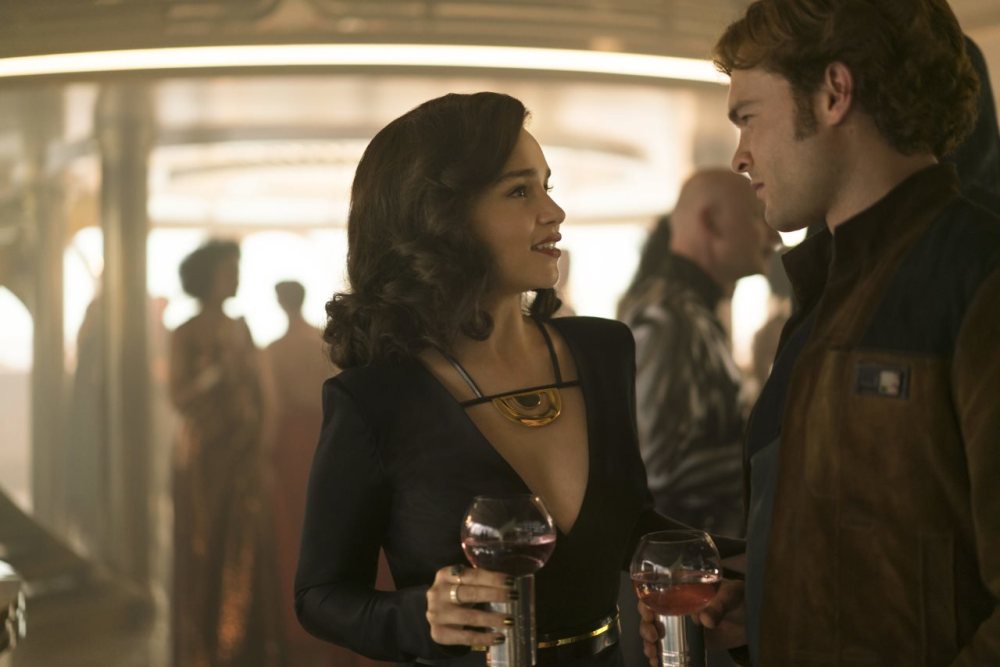
We begin with a brisk introduction to Han and his other half Qi’ra (Emilia Clarke) as unfortunate folk who are imprisoned by a gang of criminals, for whom they are also forced to steal. A botched escape attempt sees Qi-ra re-apprehended and Han left with no option but to join the Imperial Army.
solo 3 NDTV GadgetsNDTV Gadgets

Once becoming disillusioned with the Empire’s policy of bloodily colonising every planet it can get its hands on, Han defects with a group of criminals (Harrelson and Newton) and joins them in their attempt at a lucrative train heist in order to win himself the means to support a new life of freedom. Unsurprisingly, not everything pans out quite so straightforwardly as that.

The first half of the film treads all the requisite ground in predictably boring fashion. As with any movie that deals with the humble beginnings of an iconic character, there are certain boxes that require ticking. Mercifully, however, there are not many of these in Han Solo’s case, and by the end we are left with an engaging space Western that eschews predictability and feels in no way restrained by the shadow of its source material.

Alden Ehrenreich proves a good fit for the titular role, emulating Harrison Ford’s swagger and boyish charm while also adding a subtle air of youthful innocence that draws an interesting parallel with the more cold-blooded incarnation we meet in A New Hope. Donald Glover, on the other hand, takes far more dramatic license with the character of Lando Calrissian, replacing Billy Dee Williams’ brash charmer with a quirky, thoughtful, Glover-esque version. It is difficult to imagine the progression from one to the other, but Glover’s Calrissian fits well here.

solo 1 Forbes
Forbes

As for the new characters, Woody Harrelson is reliably excellent as the crafty Tobias Beckett, and Paul Bettany once again proves his flair for portraying criminal derangement as chief villain Dryden Vos. Emilia Clarke does her best as Qi’ra, but the character is poorly written and her story somewhat jumbled.

Development of this film began as far back as 2012, when George Lucas was still the owner of all things Star Wars. Many creative influences have had their say since then, with the original directing pair of Phil Lord and Christopher Miller replaced by Ron Howard in June 2017 due to “creative differences.” Despite this, the film has arrived in neat order. Howard’s direction is well-focused, and Lawrence Kasdan’s script, while overly deliberate in places, complements it well. The obligatory nods to the source material are not allowed to become overbearing, and the story’s disconnection from the central thread of the Star Wars saga allows it to become a snappy sci-fi thriller all of its own.

3/5

Film Review

Goat (2016) – A Review

Directed by Andrew Neel. Starring Ben Schnetzer, Nick Jonas, Gus Halper, Danny Flaherty, Jake Picking, Virginia Gardner, Austin Lyon, James Franco. Running time: 96 minutes.

There is a decided trend in cinematic portrayals of American college fraternities. Films like Animal House and Bad Neighbours would have us see them largely as institutions of camaraderie, debauchery and relatively harmless mischief. The parties are wild, the intoxicants flow freely, and the few females that feature are ruthlessly objectified, but underpinning all this is a keen sense of mutual loyalty and a fun-loving disdain for the dull trappings of regular civilian life. The old adage, “boys will be boys” springs to mind.

goat 2 Howard For Film
Howard For Film

Goat, however, casts a more critical eye on the cultural norms of Greek letter organizations, particularly that of hazing, the infamous induction process endured by new “pledges” to a fraternity.

The film opens with an arresting slow motion shot of a group of young topless men, jumping and shouting in an adrenaline-fueled frenzy. It sets the pace for an intense, unflinching examination of the fascinating social hierarchy that is the frat house.

Brad (an effective turn from Ben Schnetzer) must begin college while still reeling from a vicious assault he suffers at the movie’s outset. Buoyed by the promise of a hedonistic lifestyle and a protective friend group, he joins the fraternity of which his brother Brett (Nick Jonas) is an established member.

goat-movie-2 Hollywood Life Hollywood Life

Once the hazing ensues, however, the trauma of Brad’s beating begins to resurface, and he struggles to withstand the brutality of the senior frat brothers.

It is at this point that Goat begins to take a sterner look at its subject matter. The hazing rituals, which range from forced drinking to mock rape, become more intense as the film goes on, and are all detailed in an unyieldingly graphic fashion. Physical violence is largely eschewed, but we are left in no doubt as to the level of psychological abuse being inflicted.

Due in part to the notorious tradition of secrecy that shrouds the antics of American fraternities, it is difficult to say how realistic these depictions are, or how widespread such activity may be in real life. If Neel’s portrayal is to be believed, though, the frat brother is not a creature for whom we should feel very much sympathy. Compassion and mercy are non-existent within the enclosure of the frat house; new members must showcase their worthiness to enjoy the perks of life as a brother, or be cast aside. As one of the senior members inquires of the hazing process, “if they don’t have to go through hell, what’s the point?”

Goat 3 Elite Daily Elite Daily

I am no fan of the term “toxic masculinity,” but I feel that if it were to ever accurately refer to anything, it would be this. The collective overload of testosterone on display here manifests itself in the ugliest of ways.

Ethan Palmer’s camerawork does an admirable job of intensifying the action. His frequent use of prolonged close-ups, accompanied by a minimalist soundtrack, makes haunting statements. The film also has an impressive knack for portraying dramatic tension; the grey area between horseplay and real aggression, which the frat brothers tread so frequently, always comes across in sufficiently ambiguous terms to keep us in the dark as to what’s about to happen.

Goat is far from a perfect movie. One minor character whose development becomes crucial to the story arc is dealt with in too broad a fashion to elicit any emotional attachment; his ultimate contribution, surely intended to be touching, ends up being largely forgettable. Regardless of this, however, it remains a brave and worthwhile look at hugely controversial institutions and practices, written and acted with a surefooted cognizance of its subject matter.

3.5/5

Film Review

Tully – A Review

Directed by Jason Reitman. Starring Charlize Theron, Mackenzie Davis, Mark Duplass, Ron Livingston. Running time: 96 minutes

It is difficult, at the outset, to predict exactly where this film will bring you. The bright design of the theatrical release poster promises something far cheerier than what the first act provides. The synopsis mentions the fostering of a relationship between a mother and her nanny, but the film has progressed considerably before said nanny is allowed to make her first appearance.

Charlize Theron plays Marlo, a droll and heavily pregnant mother of two. The stresses of both her existing and impending motherhood, compounded by the difficult behaviour of her apparently autistic son Jonah, begin to take their toll on her mental wellbeing. After the birth, things get worse, and Marlo is plunged into what looks like a rather severe depressive episode.

tully 1 varietyVariety

Although she and her well-meaning, if somewhat detached, husband Drew (Ron Livingston) are initially reluctant about the idea, a night nanny is hired to alleviate some of Marlo’s stress. Enter Tully (Mackenzie Davis). Tully has a knack for both childcare and sympathetic companionship, and her presence quickly becomes a great comfort to Marlo as she unpacks her weariness of suburban family life.

The film takes us to a variety of places. It feels initially as though we are to be treated to a blackly comical reflection on the blandness of family life. Marlo moans half-heartedly about her pedestrian job in HR and her husband and brother share a mild mutual disdain. When Tully arrives, it appears that we have moved more into the realm of a relatively cheerful buddy movie; the pair do each other’s hair and cackle irreverently about their sex lives. So far, so familiar. By the end, however, what emerges is a cleverly woven psychological drama, playing on each of the above motifs to create a bold and innovative film. Subtle foreshadowing and misdirection create a sense of uncertainty that is nicely resolved with a clever final sequence.

tully 2 vultureVulture

Mackenzie Davis performs the titular role with a delightful eccentricity, but Theron’s dedication and masterful dynamism steal the show. She carefully takes the edges away from Marlo’s playful personality as stress and depression take hold, allowing circumstances to have their bearing on her manner without ever compromising the character as a whole. She gained significant weight for the role; weight, reports tell us, it subsequently took her a year and a half to lose. The possibility of a third Oscar nomination for the 41-year-old is far from inconceivable, although there is a long way to go until the 2019 awards.

A word of caution must be offered for those who may be squeamish about the physical realities of new motherhood; Jason Reitman has no qualms about getting graphic. Scenes featuring swollen breasts and leaking nipples abound. This ties in with Reitman’s wish to make the film as straightforwardly honest as possible about the trials of parenthood, and it works. It works so well, in fact, that many of its childless viewers might well decide never to entertain the notion of starting a family again. You have been warned.

Tully 3 RTERTE

Ignore the self-righteous online whinging about the movie’s tone and its supposed mistreatment of mental health issues. Marlo’s struggle is approached with sincerity and tenderness, and comic moments never detract from the seriousness of the core subject matter. We may not get a forensic analysis of her difficulties, but to say that their treatment does a disservice to mental health awareness generally is a considerable stretch.

Overall, Tully does a good job of achieving what it sets out to. Leave your expectations at the door and you should enjoy it just fine.


3.5/5

Film Review

Deadpool 2 – A Review

Directed by David Leitch. Starring Ryan Reynolds, Josh Brolin, Morena Baccarin, Julian Dennison, Zazie Beetz, T.J. Miller, Brianna Hildebrand, Jack Kesy. Running time: 119 minutes.

It is difficult to think of many sequels that better their predecessors quite so emphatically as Deadpool 2. The Dark Knight managed it, as did The Empire Strikes Back, and both of these have arguably come to be considered modern classics. It is very unlikely that this will achieve such recognition in the history of film, but it is a very good movie nonetheless.

Highsnobriety

Before going to see it, I would not have thought I would be beginning my review as such. The first film introduced the idea of an uncouth, sadistic, wisecracking superhero to passable effect. The action sequences were flashy at first, but tiresome by the end; the comedy fell flat as often as it drew laughs. It wasn’t a disastrous film by any means, but one did leave the cinema with the distinct impression that the concept’s supply of innovative entertainment had been exhausted by the end, and that the sequel (which was boldly announced during the end credits) would surely struggle to achieve much other than making a splash at the box office.

Deadpool (Ryan Reynolds) is a walking parody of both himself and the superhero genre. He uses his indestructibility for comic effect, he kills foes indiscriminately and he delights in irreverent meta-references. This film starts with him enjoying his newfound celebrity status and gleefully butchering stereotypical gangs of villains. Until, that is, his beloved girlfriend (Morena Baccarin) is killed by the stray bullet of a vengeful enemy, plunging the antihero into a depression which culminates in a suicide attempt (which, because of the aforementioned indestructibility, doesn’t work).

deadpool 2 screengeek

ScreenGeek

He then ends up in the care of the X-Men (a franchise the film mocks ruthlessly), befriends a hotheaded young mutant named Firefist (Julian Dennison), tangles with the mysterious Cable (Josh Brolin), assembles a team of mutant helpers, and squeezes in a few fleeting moments of sincerity between massive stretches of unrelentingly gory ridiculousness.

The story rarely exhibits any sense of structure or purpose, and it probably isn’t supposed to. This is a film that backs itself into the corner of complete reliance on its comedy; the sort of film that can only avoid being utterly dreadful if it’s funny. Thankfully, it’s very funny indeed.

The humour is broad and unflinching, and jokes court controversy with far greater abandon this time around. There are several one-liners about sexual abuse, and race-baiters are targeted repeatedly. Obviously, this sort of humour does not appeal to everyone, and it isn’t difficult to imagine the film attracting criticism for being too racy. That said, Reynolds et al.’s unwillingness to kowtow to modern standards of acceptable expression is eminently refreshing.

deadpool 3 vulture

Vulture

There is also a noticeable uptick in bloody violence since Deadpool’s last outing. This may be due to the creative influence of new director David Leitch, who was responsible for John Wick, or it may simply be another symptom of the “kitchen sink” spirit that the franchise embodies. Either way, it plays well with the meticulously choreographed action sequences, if you have the stomach for it all.

The film’s other major weapon is its protagonist. It seems quite possible that this is the role Ryan Reynolds was born to play; Deadpool’s ceaseless witticisms and faux-sincerity play to his comedic strengths perfectly. His profound nonchalance seems to dare onlookers to disapprove of him (and the material gives them plenty to disapprove of). It works beautifully.

It is difficult to say exactly why this film has made its presence felt so much more effectively than its predecessor, but its utter disregard for good taste certainly helps. This is undoubtedly a film to divide opinion. However, if you aren’t easily offended by risqué jokes or gratuitous violence, and you enjoy Ryan Reynolds’ deadpan schtick, this may well be the thing for you.

4.5/5

Film Review

Michael Inside – A Review

Directed by Frank Berry. Starring Dafhyd Flynn, Lalor Roddy, Moe Dunford, Robbie Walsh. Running time: 96 minutes

Michael Inside is the second major Irish film of 2017 to concern itself with the criminal elements of working-class Dublin, the first being the excellent Cardboard Gangsters. In that film, however, John Connors’ brash protagonist was an unabashed aspirant to the upper echelons of Ireland’s criminal underworld. His was a character we were supposed to root for, if only in a guilty pleasure, Scarface sort of way.

Michael McCrea (Dafhyd Flynn), on the other hand, is largely a tragic victim of circumstance. After he agrees to hold a quantity of drugs for a friend, Gardai raid the home he shares with his grandfather (played movingly by Lalor Roddy) and find it. Coupled with a previous offence for which he was on probation, this is sufficient to see him incarcerated. From there, the film examines crime and imprisonment from a number of angles.

michael inside 1 entertainment.ie
Entertainment.ie

The character of Michael, played with a stunning solemnity by Flynn, is a perfect conduit for the film’s message. He greets his troubles with an apparent apathy, leading one to believe initially that he may be the type of impossibly composed hard man that exists only in fiction. The truth is revealed gradually with a beautiful light touch, displays of emotion all the more valuable for their rarity.

Berry has done a fine job of layering his story, and is determined that we should not jump to any convenient conclusions about it. Michael may be a product of his environment, but he is also an active participant in it, and it is not easy to say whether he deserves the various fates that befall him. His grandfather displays a haunting cognizance of this; he seeks to guide and support his grandson, but understands the helplessness of his situation and can ultimately offer little real advice other than to remind him that there are “good people in there too.”

michael inside 3 entertainment.ie
Entertainment.ie

Michael Inside triumphs as a character-driven drama. Close, emotive camerawork complements an impeccable set of acting performances to create a movie with real emotional power. It functions equally brilliantly in its dissection of our justice system, and the failings therein.

We are told at the outset that research for this film was conducted with past participants in the Irish Prison Service’s Pathways program. This instils a grim sense of reality in the events that occur behind the prison gates. Bullying, beatings, blackmail and mutilation are a consistent reality. Inmates that come across as decent still possess a ruthless consciousness of the need to self-preserve. The most striking aspect to the examination of incarcerated life is mentioned nonchalantly by a Garda towards the start of the film; “you’ll get used to it.” We see the way in which prison moulds its inhabitants, and the brutality of the “revolving door” mechanism so often admonished in discussions about justice.

michael inside 2 rte
RTE

Michael Inside’s 96 minutes are carefully used; minor characters are sparingly detailed, and dialogue is sparse throughout. These tactics produce a clear sense of focus. The tragedy faced by Michael, and to perhaps an even greater extent by his grandfather, is inescapable.

This is a film that has succeeded beautifully in all of its endeavours; that it was named Best Feature Film at this year’s IFTAs is no injustice. A must-see for fans of Irish film.

5/5

Film Review

Lady Bird – A Review

Directed by Greta Gerwig. Starring Saoirse Ronan, Laurie Metcalf, Tracy Letts, Lucas Hedges, Timothée Chalamet, Beanie Feldstein, Stephen McKinley Henderson, Lois Smith, Odeya Rush. Running time: 93 minutes.

The early 2000s are now long enough ago that cinematic examination of their culture qualifies as nostalgic. One experiences a fond twinge upon seeing the blocky mobile phones and home computers. One is slightly startled to realize that Saoirse Ronan’s teenage protagonist would be in her mid-thirties today.

Current Magazine

Gerwig’s selection of this time period is clever. The principles that govern social interaction between young adults are largely the same, but the social media age has not yet dawned, and teenage privacy is intruded upon far less than would be the case today. The uncertainty this allows for is vital to the plot on a few occasions.

Ronan shines as Christine McPherson, an eccentric young lady who insists on being addressed only as Lady Bird. Her character explores all the typical issues facing those crossing the threshold into adulthood; body image, sexuality, friendship, acceptance (or lack thereof). Romance is the focus of large sections of the film, firstly with the kindly Danny (Lucas Hedges) and then with the supremely indifferent Kyle (Timothée Chalamet).

While the feeling on display here is admirably authentic, one cannot shake the air of predictability that goes with it. The theme of friendship is explored in similarly recognizable terms; Julie (Beanie Feldstein) is Lady Bird’s uncool best friend, while Jenna (Odeya Rush) is a more glamorous sort whose company offers social elevation, and Lady Bird is ultimately left with a choice between the two.

Lady Bird 2Entertainment.ie

It is the McPherson family dynamic that really makes use of this film’s knack for powerful character interplay. Lady Bird’s disillusionment with her home life is brought to life in energetic fashion, not least because of a towering display from Laurie Metcalf in the role of her mother. Marion McPherson is a doggedly practical woman, determined to point her children in the direction of a respectable and comfortable life due to the financial difficulties she experiences herself. Gerwig has created a finely nuanced character here; we are not sure how much to let ourselves like Marion, as her manner is abrasive to what can seem an unnecessary extent, but one cannot help but sympathise with her position. Father Larry (Tracy Letts) is a gentler soul with whom Lady Bird identifies much more easily, and who is admonished by his wife for adopting the role of “the good guy.”

Lady Bird’s biggest selling point is its characters and the skill with which they are acted, particularly in the cases of Ronan and Metcalf, both of whom received an Oscar nomination for their troubles. This is enough to make up for what is a bare storyline which carves itself a foreseeable path. It ultimately does little to distinguish itself from other coming-of-age dramas, but remains a worthwhile watch that achieves what it sets out to.

3/5

Television

Damnation – A Review

Created by Tony Tost. Starring Killian Scott, Logan Marshall-Green, Sarah Jones, Chasten Harmon, Christopher Heyerdahl, Melinda Page Hamilton, Joe Adler. Runs for 10 episodes.

It’s good to see Killian Scott back on a TV screen. While many non-Irish viewers will be unable to distinguish him from any of the other main players on the overpopulated conveyor belt of new dramas on Netflix, he is instantly recognisable here as Love/Hate’s tragic lothario Tommy Daly, one of Irish television’s best known roles while the series was running.

Damnation - Season 1

IndieWire

While his contribution there was an almost entirely indifferent one (it was nearly as if someone had challenged him to show as little emotion as possible onscreen), his leading role here requires more nuance, which he handles adeptly. Introduced to us as a preacher, Seth Davenport’s overtly impious actions, as well as his innovative interpretations of scripture, lead one to suspect that he is not a typical man of the cloth.

The drama begins in the cloak-and-dagger fashion that is typical of new series; plot twists and reveals are drip-fed at deliberate intervals. Davenport has organised a strike amongst local farmers in the Iowa town of Holden, in which this show is largely set. Creeley Turner (Logan Marshall-Green) is the man entrusted with the job of ending the strike, and is thus referred to mainly as the “strike-breaker”. Turner makes his entrance in conspicuous fashion when he murders a striker in cold blood, enraging the inhabitants of the town. The suspicion that there may be a secret link between Turner and Davenport is not left unconfirmed for long.

damnation 2

CinemaBlend

The theme of struggle between impoverished working classes and an indifferent elite works well in the setting of Depression-era America, but there is little innovation in terms of how it is presented. The striking farmers are a uniformly good-natured bunch, while the bankers and business owners determined to end their strike are stereotypical rich oppressors.

This sharp dichotomy is, regrettably, maintained in the relationship between Turner and Davenport. Turner is rarely allowed to come across as anything other than a bloodless minion of his wealthy employers, while Davenport is tender and altruistic but admirably tough as well. We are left in no doubt as to who we’re supposed to be shouting for.

While Davenport’s character is detailed enough to be believable, however, Turner’s is not. His present-day incarnation is a stony-faced cowboy, who Green tries very hard to turn into Tom Hardy’s Forrest Bondurant from Lawless. A series of flashbacks shows us that he was once a much softer sort, incapable of doing harm to others; by the apparent standards of the day, a wimp. The contrast promises some sort of diverting subplot regarding his transformation into an unfeeling killer. This promise remains unkept, however, and we are left to conclude that Turner’s character must simply have changed by magic.

damnation 3

Bustle

Many of the supporting roles are equally one-dimensional, as well as poorly acted. While Tost has failed to produce a compelling character-driven drama, however, he has succeeded in taking an elegant snapshot of the heartland of 1930’s America. The bleak settings are captured in a visually stunning manner, and the soundtrack builds its atmosphere beautifully. We are made to understand the harshness of existence for ordinary people of that generation, and we get a heartfelt (if somewhat one-sided) reflection on their plight.

It has been reported that Damnation will not be recalled for a second season, probably due to poor performance in terms of viewer numbers. If you are the kind of person who does not warm to open endings, then you may not wish to invest your time in this show, as these ten episodes were obviously not intended as a standalone production. If that doesn’t concern you, however, rest assured that there are far worse creations on Netflix than this.

2.5/5

Film Review

Three Billboards Outside Ebbing, Missouri – A Review

Directed by Martin McDonagh. Starring Frances McDormand, Woody Harrelson, Sam Rockwell, Peter Dinklage, Abbie Cornish, Caleb Landry Jones, Lucas Hedges. Running time: 115 minutes.

Here we have the film that bears the greatest weight of expectation coming into the Academy Awards in March. Frances McDormand, it seems, is certain to claim Best Actress, and it also appears unlikely that Sam Rockwell will be denied Best Supporting Actor. Three Billboards also has a very credible chance of landing the big one; The Shape of Water is the current favourite, but Academy voters have exhibited an obvious preference for gritty drama in the Best Picture category in recent history, as well as a certain disregard for films with a fantasy or sci-fi element. Time will tell. Whatever its eventual haul of awards, this is certainly an enjoyable film, with McDonagh’s relentlessly morbid humour returning in fine fashion.

ebbing 1The Atlantic

The titular billboards are rented by McDormand’s Mildred Hayes, and are inscribed with an explicitly worded inquiry as to the failure of the local police investigation into the rape and murder of her daughter. Chief Bill Willoughby (Woody Harrelson), to whom the message is personally addressed, is tasked with persuading the incorrigible Ms Hayes to remove the billboards, while also assuring her of his department’s continued efforts to apprehend her daughter’s attacker.

Everything progresses in civilised fashion for the first while. McDormand is resolute and stony-faced, and beautifully, hilariously impassive in the face of opposition. Harrelson is level-headed and wise, but frustrated by his opponent’s stubbornness. An abrupt twist in the narrative at about the halfway stage sees things descend rapidly into chaos.

THREE BILLBOARDS OUTSIDE OF EBBING, MISSOURICollider

McDormand’s performance is impeccable from the moment she appears onscreen. She brings a fierce energy to the role, and caps it beautifully in her exploration of the chinks in Mildred’s emotional armour. The film’s overarching motif is the examination of her perseverance in the face of unimaginable emotional turmoil, as well as attempts by others to undermine her. McDormand’s turn breathes life into it with magnificent style and feeling. Sam Rockwell also has tremendous fun with his dim-witted, racist cop, and proves to be a perfect outlet for Martin McDonagh’s distinctive style of black comedy.

The supporting performances are equally enjoyable. Caleb Landry Jones is effective as the unfortunate soul responsible for leasing the billboards to Mildred. Lucas Hedges also performs well as the son driven close to madness by the ineffable obstinacy of his mother.

ebbing 3Flickering Myth

The script has McDonagh’s trademark earthiness to it, creating a cast of eminently believable characters and weaving comic and tragic elements with deftness. It also creates an engaging setting, which is augmented by beautiful cinematography. Unfortunately, however, the story is allowed to stagnate in the second half, and the dramatic tension which builds sensationally from the opening scenes is allowed to ebb away towards the end.

Nevertheless, McDonagh has made a fine film, one that is not overshadowed by the masterful debut that was In Bruges, and that makes a marked improvement on Seven Psychopaths, his most recent offering. Their night on the red carpet in March will be well deserved.

4/5

Film Review

Star Wars: The Last Jedi – A Review

Directed by Rian Johnson. Starring Daisy Ridley, Mark Hamill, Adam Driver, John Boyega, Oscar Isaac, Andy Serkis, Domhnall Gleeson, Kelly-Marie Tran, Benicio Del Toro. Running time: 152 minutes.

Within the first ten minutes of this movie, the Star Wars universe has produced its first “your mother” joke. Make of it what you will. Funny or not, though, it has the significance of indicating to us that Rian Johnson’s vision for this franchise does not involve adherence to the unwaveringly solemn tone that used to prevail in the galaxy far, far away. Long gone is the rigid dialogue favoured by George Lucas and co.

star wars 1

Considering the fact that critics (and, famously, Harrison Ford) used to lambast Star Wars scripts of old, this may not be a bad thing. Of greater concern, however, is the utter disregard Johnson shows for consistency with the earlier material. Lackeys with primitive weapons are now a match for talented lightsabre-wielders. The Force now endows one with the ability to survive massive explosions and breathe in outer space. The casual viewer should not be concerned, but anyone going to the cinema expecting something that is actually a Star Wars sequel will be left scratching their heads.

After the aforementioned quip manages to distract First Order (the new Empire, basically) forces long enough for Resistance (the new Rebellion, more or less) fighters to claim an unlikely victory in the opening battle, the former chases the latter across the galaxy in a big, black, chrome thing that bears an uncanny resemblance to what Darth Vader used to cruise around in. Meanwhile, Rey (Daisy Ridley) takes in the scenery of Skellig Michael (known in the movie as Ahch-To), while also attempting to convince a now much older and crankier Luke Skywalker (Mark Hamill) to teach her the ways of the Force.

The flaws are glaring, and plentiful. After the plot contrivances, the most egregious is Johnson’s script; gags aside, he hasn’t improved on Lucas’ template that much. There is much vague blabber about “power” and “destiny”, and some unprecedentedly corny utterances in the final act.

star wars 3

The development of Luke and Rey’s relationship is reasonably entertaining. Ridley does a fine job of portraying her character, deftly navigating the coming-of-age narrative that has featured so prominently in the Star Wars universe since its inception. Andy Serkis and Adam Driver also do an interesting job on the interactions between Snoke and Kylo Ren, although this storyline feels almost self-plagiarised by the end (Snoke is effectively the Emperor from the original trilogy with a better costume designer). Kylo Ren does offer engaging variations on the theme of villain in black, however; where Darth Vader was clinical and collected, Ren is irascible and unpredictable. His is a character with depth and dimensions, and Driver does a laudable job of bringing them to bear.

The rest of the story, however, is poor. Princess Leia (Carrie Fisher) and Poe Dameron (Oscar Isaac) argue about how best to shake their pursuers, led by General Hux (a disappointingly hammy Domhnall Gleeson), but very little material of any entertainment value arises. Finn (an excessively enthusiastic John Boyega) and new addition Rose Tico (Kelly-Marie Tran) embark on a largely pointless and painfully predictable sideshow to find a codebreaker, although this does involve a passably amusing turn from Benicio Del Toro. We get some reflection on the tyranny of the First Order, but not enough to convince us that the whole subplot is anything more than filler, and unnecessary filler at that. At 152 minutes, this is the longest instalment in the saga, and manages to feel even longer than it is.

star wars 2

One of the reasons for this film’s shortcomings is the size of its ensemble cast; too many storylines are forced upon us, and must be wrought into a mutual ending which goes way, way over the top. This does allow for the flaunting of breath-taking audio and visual effects, which have bagged a couple of Oscar nominations along with John Williams’ score, but does nothing for the broader appeal of the film.

Ultimately, while there are some redeeming elements, this film is not one of the prouder products of the Star Wars galaxy.

1.5/5

Film Review

Good Time – A Review

Directed by Ben & Josh Safdie. Starring Robert Pattinson, Ben Safdie, Jennifer Jason Leigh, Barkhad Abdi, Buddy Duress. Running time: 99 minutes.

Robert Pattinson certainly has come a long way since his acting debut in Harry Potter and the Goblet of Fire 12 years ago. His generic teenaged heartthrob in that film, as well as the slightly older and far paler reincarnation in the Twilight saga, made him into a household name. His role here as Connie Nikas, an unwashed, uninspired and frankly rather unpleasant Queens bank robber, is not likely to reignite the hysterical fandom that he once enjoyed. Regardless, it is an excellent performance.

good time 1

Good Time is a film that is economical with its detail, and efficient in its focus. The opening scene takes place in a therapist’s office; it informs us that Connie’s brother Nick (Ben Safdie) is mentally handicapped, and has been taken under observation for a sparsely outlined violent incident. Cue an infuriated interruption from Connie, and before long we are in the middle of the bank robbery that sets the wheels of this film in motion. Executed with painful idiocy, the robbery’s aftermath does not go as expected, and a caper ensues which will involve deception, violence, drugs, more robbery, some dreadful decision-making and many moments that manage to be both hilarious and disturbing at the same time.

Minor players float in and out of the spotlight over the course of the 99 minutes, but Pattinson’s character largely remains the focus. He is exposed as a rash and ruthless antihero, who is wholly untroubled by the suffering of others. He is, however, fiercely dedicated to preserving his brother from harm, and unafraid to make sacrifices to achieve this end. The irony, of course, is that his chosen methods often do less good than harm, and have almost invariably toxic consequences for anyone unfortunate enough to wander into his path. Pattinson’s portrayal is cold and unflinching, and it works beautifully.

good time 2

Ben Safdie also acquits himself well, although his portrayal of mental incapacity is sometimes less than innovative. Jennifer Jason Leigh shines as Connie’s gullible white-trash girlfriend.

A gripping opening sequence sets up what could have been as good a thriller as you’ll see. Regrettably, however, the middle act features a lot of meandering, and the plot starts to lose its magnetism after too many improbable twists. Despite this, the final sequence is beautifully done, skilfully tying together the film’s overarching themes and packing a strong, emotive punch. The camerawork is a pleasure to watch, and Oneohtrix Point Never’s brooding electronic soundtrack adds a delightful layer of intensity throughout.

3.5/5